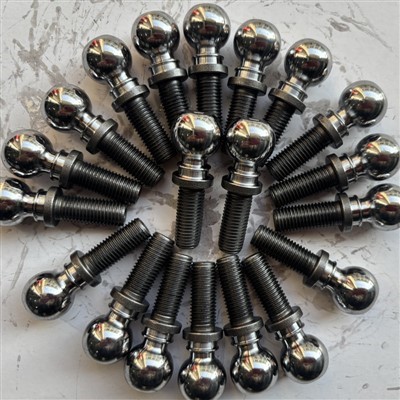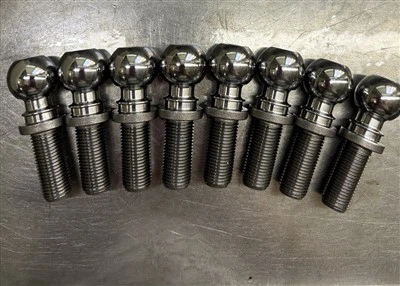
The mechanical integrity of a vehicle's suspension system often depends on the smallest connectors, particularly when a driver demands absolute feedback from the steering wheel. To bridge the gap between the stabilizer bar, steering link, and suspension arm, a high-performance Precision Ball Joint is required to facilitate fluid movement without the annoying "play" found in standard OEM components. Unlike mass-produced alternatives that use basic cast iron or low-carbon steel, these high-spec units are manufactured from wear-resistant alloy steel processed through vacuum melting. This metallurgical technique ensures high material purity, resulting in a dense structure completely free of internal inclusions or voids that typically lead to structural fractures. This level of purity allows the component to achieve a tensile strength exceeding 950 MPa, allowing the chassis to withstand aggressive cornering, heavy compression, and high-frequency fatigue without deformation. Recent news from specialty steel suppliers indicates that vacuum-melting capacity is tightening globally, yet the demand continues to rise as performance enthusiasts move away from soft rubber bushings toward rigid, metallic connections. Furthermore, the surface of these joints undergoes hard chrome plating to reach a hardness of HV800, providing a protective shield that is two to three times tougher than regular steel, effectively guarding against road salt and abrasive debris over thousands of miles.
Technicians specialized in automotive performance consulting often point out that steering accuracy is compromised the moment a linkage becomes even slightly loose. Replacing a worn-out stabilizer link with a dedicated Precision Ball Joint is the most effective way to restore the geometric alignment of the front end and sharpen the turn-in response. When comparing these professional components to generic parts, the primary difference lies in the 5-axis CNC machining process, which allows for a single-setup production that eliminates cumulative dimensional errors. Size precision is controlled within a staggering ±0.01 mm, ensuring a seamless fit that prevents the "clunking" noises often associated with poorly tolerance hardware. For enthusiasts or mechanics planning an upgrade, the usage steps are quite methodical: first, lift the vehicle to remove tension from the anti-roll bar; second, clear any corrosion from the mounting holes; and third, secure the joint using high-torque lock nuts to ensure the ball stud remains centered. If you are operating a professional modification shop, staying informed on raw material dynamics is key, as the current market favors high-density alloys that maintain their mechanical properties under extreme heat. Choosing a professionally-graded Precision Ball Joint ensures that the vehicle remains stable during high-speed maneuvers, proving that premium steel and rigorous 3D inspection are critical for anyone who values both occupant safety and peak mechanical performance on the road or the track.