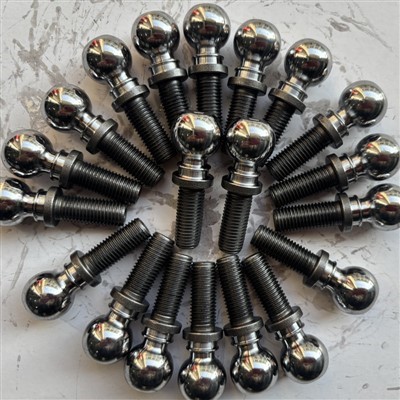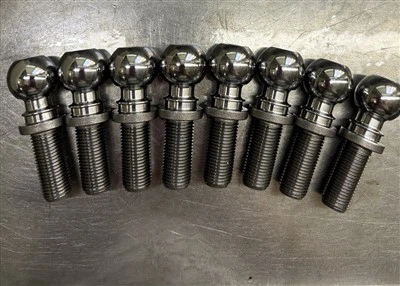
The function of automotive inner and outer ball joints is to connect the suspension system to the stabilizer bar linkages, thereby transmitting forces between the suspension and the stabilizer bar. If either the inner or outer ball joint becomes damaged, it will directly compromise the proper functioning of both the suspension and the stabilizer bar.
The role of an automotive ball joint is to serve as a mechanical structure that utilizes a spherical connection to transmit force across different axes. When an automotive ball joint fails, the following symptoms may manifest:
1. A distinct "clunking" or rattling sound when driving over bumpy terrain;
2. Vehicle instability, characterized by swaying from side to side;
3. Braking deviation (the vehicle pulling to one side while braking).
Automotive ball joints-also sometimes referred to as universal joints-are critical components of a vehicle; they function as mechanical structures that employ a spherical linkage to facilitate the transmission of force between intersecting axes.
Failure of the front-wheel ball joints typically presents the following symptoms: clunking noises on rough roads; vehicle instability and lateral swaying; braking deviation; and steering failure. If the ball joint develops excessive play (looseness), it becomes highly susceptible to sudden fracture when subjected to impact loads. It is imperative to have the component repaired as soon as possible to prevent dangerous situations. Specifically, the "outer ball joint" refers to the tie rod end, while the "inner ball joint" refers to the steering rack tie rod end.
The outer and inner ball joints are not physically connected to one another, yet they are designed to function in tandem. The steering rack ball joint connects to the steering knuckle, while the tie rod ball joint connects to the tie rod itself.
Automotive ball joints utilize a spherical connection to transmit power between components that are not aligned on the same axis. This design facilitates multi-angle rotation, enabling the steering mechanism to operate smoothly, thereby reducing vibration and ensuring fluid steering performance.
Ball joints are also referred to as universal joints; this term denotes a mechanical structure that employs a spherical linkage to transmit power between non-coaxial shafts. The universal joint is a critical component in automobiles. When combined with a driveshaft, the universal joint forms a "universal joint transmission assembly." In vehicles featuring a front-engine, rear-wheel-drive configuration, this transmission assembly is positioned between the transmission's output shaft and the input shaft of the drive axle's final drive unit. Conversely, in front-engine, front-wheel-drive vehicles-which typically omit a driveshaft-the universal joint is situated between the front axle half-shaft (which handles both propulsion and steering duties) and the wheel.