
What is the elastic modulus of a stainless steel ball joint?
As a supplier of stainless steel ball joints, I am often asked about the elastic modulus of these components. Understanding the elastic modulus is crucial for engineers, designers, and anyone involved in the selection and application of stainless steel ball joints. In this blog post, I will explain what the elastic modulus is, why it matters for stainless steel ball joints, and how it affects their performance.
Understanding the Elastic Modulus
The elastic modulus, also known as Young's modulus, is a measure of a material's stiffness or resistance to elastic deformation. It is defined as the ratio of stress (force per unit area) to strain (deformation per unit length) within the elastic range of the material. In simpler terms, it tells us how much a material will stretch or compress under a given load.
Mathematically, the elastic modulus (E) is expressed as:
[ E = \frac{\sigma}{\epsilon} ]
where (\sigma) is the stress and (\epsilon) is the strain.
The elastic modulus is typically measured in pascals (Pa) or gigapascals (GPa). For stainless steel, the elastic modulus generally ranges from about 190 to 210 GPa, depending on the specific alloy and its composition.
Importance of Elastic Modulus for Stainless Steel Ball Joints
The elastic modulus plays a significant role in the performance of stainless steel ball joints. Here are some key reasons why it is important:
- Load-bearing capacity: The elastic modulus determines how much load a ball joint can withstand without permanent deformation. A higher elastic modulus means the ball joint can handle greater loads before reaching its elastic limit.
- Deflection and stiffness: The elastic modulus affects the amount of deflection or deformation that occurs when a load is applied to the ball joint. A higher elastic modulus results in less deflection, making the ball joint stiffer and more resistant to bending or flexing.
- Vibration and shock absorption: The elastic modulus also influences the ball joint's ability to absorb vibrations and shocks. A ball joint with a higher elastic modulus can better dampen vibrations, reducing noise and improving the overall comfort and performance of the system.
- Fatigue resistance: The elastic modulus is related to the fatigue resistance of the ball joint. A higher elastic modulus can help prevent fatigue failure by reducing the stress concentration and minimizing the accumulation of damage over time.
Factors Affecting the Elastic Modulus of Stainless Steel Ball Joints
The elastic modulus of a stainless steel ball joint can be influenced by several factors, including:
- Alloy composition: Different stainless steel alloys have different elastic moduli. For example, austenitic stainless steels generally have a higher elastic modulus than ferritic or martensitic stainless steels.
- Heat treatment: Heat treatment can affect the microstructure and mechanical properties of the stainless steel, including the elastic modulus. Annealing, for example, can increase the ductility and reduce the elastic modulus, while quenching and tempering can increase the strength and elastic modulus.
- Manufacturing process: The manufacturing process used to produce the ball joint can also impact the elastic modulus. For example, forging or machining can introduce residual stresses that can affect the material's properties.
- Temperature: The elastic modulus of stainless steel decreases with increasing temperature. This means that the ball joint may become less stiff and more prone to deformation at higher temperatures.
Measuring the Elastic Modulus of Stainless Steel Ball Joints
There are several methods for measuring the elastic modulus of stainless steel ball joints, including:
- Tensile testing: Tensile testing involves applying a gradually increasing load to a specimen of the ball joint material until it reaches its breaking point. The stress and strain are measured during the test, and the elastic modulus is calculated from the slope of the stress-strain curve within the elastic range.
- Dynamic mechanical analysis (DMA): DMA measures the viscoelastic properties of the material, including the elastic modulus, by subjecting the specimen to a sinusoidal load at different frequencies and temperatures.
- Ultrasonic testing: Ultrasonic testing uses high-frequency sound waves to measure the velocity of sound in the material. The elastic modulus can be calculated from the sound velocity and the density of the material.
Applications of Stainless Steel Ball Joints and the Role of Elastic Modulus
Stainless steel ball joints are widely used in various industries, including automotive, aerospace, marine, and industrial machinery. Here are some examples of how the elastic modulus of stainless steel ball joints affects their applications:
- Automotive suspension systems: In automotive suspension systems, stainless steel ball joints are used to connect the control arms to the steering knuckles or the suspension links. The elastic modulus of the ball joints affects the handling, stability, and comfort of the vehicle. A higher elastic modulus can improve the responsiveness and precision of the steering, while a lower elastic modulus can provide better shock absorption and ride comfort.
- Aerospace applications: In aerospace applications, stainless steel ball joints are used in aircraft control systems, landing gear, and engine mounts. The high elastic modulus of stainless steel makes it suitable for these applications, as it can withstand the high loads and stresses encountered during flight.
- Marine applications: In marine applications, stainless steel ball joints are used in boat steering systems, outboard motors, and other marine equipment. The corrosion resistance and high elastic modulus of stainless steel make it ideal for these applications, as it can withstand the harsh marine environment.
- Industrial machinery: In industrial machinery, stainless steel ball joints are used in conveyor systems, robotics, and other equipment. The elastic modulus of the ball joints affects the accuracy and reliability of the machinery, as well as its ability to handle heavy loads and vibrations.
Conclusion
In conclusion, the elastic modulus is an important property of stainless steel ball joints that affects their performance, load-bearing capacity, and durability. As a supplier of stainless steel ball joints, we understand the importance of providing high-quality products with the right elastic modulus for our customers' applications.
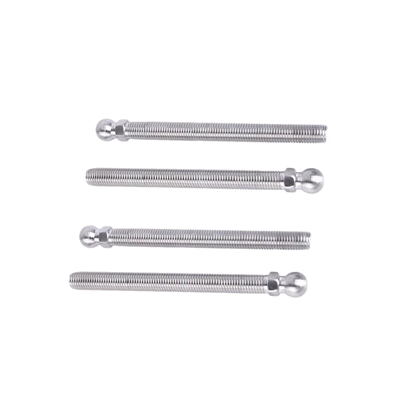
If you are in the market for stainless steel ball joints, we offer a wide range of products to meet your needs. Our Rear Anti Roll Bar Linkage Ball Joint, Anti Roll Bar Linkage Ball, and Nearside Rear Anti Roll Bar Linkage Ball Joint are all made from high-quality stainless steel and are designed to provide excellent performance and reliability.


If you have any questions or would like to discuss your specific requirements, please feel free to contact us. We look forward to working with you to find the perfect stainless steel ball joints for your application.
References
- Callister, W. D., & Rethwisch, D. G. (2010). Materials Science and Engineering: An Introduction. Wiley.
- Ashby, M. F., & Jones, D. R. H. (2005). Engineering Materials 1: An Introduction to Properties, Applications and Design. Butterworth-Heinemann.
- Schmid, F., & Boes, R. (2004). Stainless Steels: Properties, Production, Applications. Wiley-VCH.