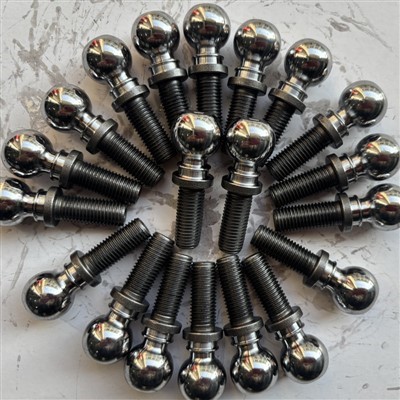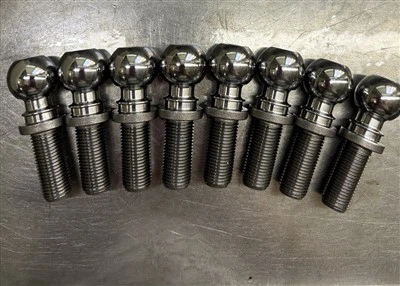
The steering tie rod ball joint is one of the core components of a vehicle's steering system; its primary function is to connect the steering mechanism to the wheels, thereby facilitating steering movements through the flexible rotation of its ball-and-socket structure. Its performance directly impacts steering precision, durability, and driving safety-particularly in heavy-duty vehicles or under complex road conditions, where the requirements for parameters such as material strength and angular range are significantly higher.
The steering tie rod ball joint consists of several components, including the ball stud, connecting rod, and bearing seat; its core design lies in the mating structure between the ball stud and the ball socket. Taking the Meiribo Model 1631-2919012-30 as an example, its ball stud oscillation angle reaches 60°, enabling it to accommodate large-angle steering requirements. The connecting rod features a specification of 10mm in both outer and inner diameter, striking a balance between structural strength and lightweight design. Constructed from 45# steel, the component undergoes a heat treatment process to enhance its fatigue resistance. Among its key parameters, an output torque of 10 Nm and an operating pressure of 9 MPa indicate its suitability for high-load applications, while the specified front axle load capacity of 1 ton clearly defines the applicable load range for compatible vehicle models.
The technical parameters of this product are directly correlated with its intended application scenarios. For instance, the design featuring a piston stroke of 12 mm and a spool valve stroke of 10 mm serves to optimize the response speed of the hydraulic power-assist system; a 1:1 assist ratio configuration ensures uniform steering effort; and a steering lock-to-lock characteristic of one turn makes it well-suited for engineering vehicles that require rapid steering maneuvers. The product is applicable to a wide range of vehicle types-including tractors, light trucks, heavy-duty trucks, and construction machinery-primarily because its specific dimensions-such as an assembly profile of 12 mm and a flange height of 8 mm-allow it to fit within the installation space constraints typical of non-passenger vehicle chassis. Furthermore, the standardized design-featuring four mounting holes with a diameter of 10 mm and a kingpin hole diameter of 10 mm-facilitates seamless compatibility with the steering arms of most vehicle models.